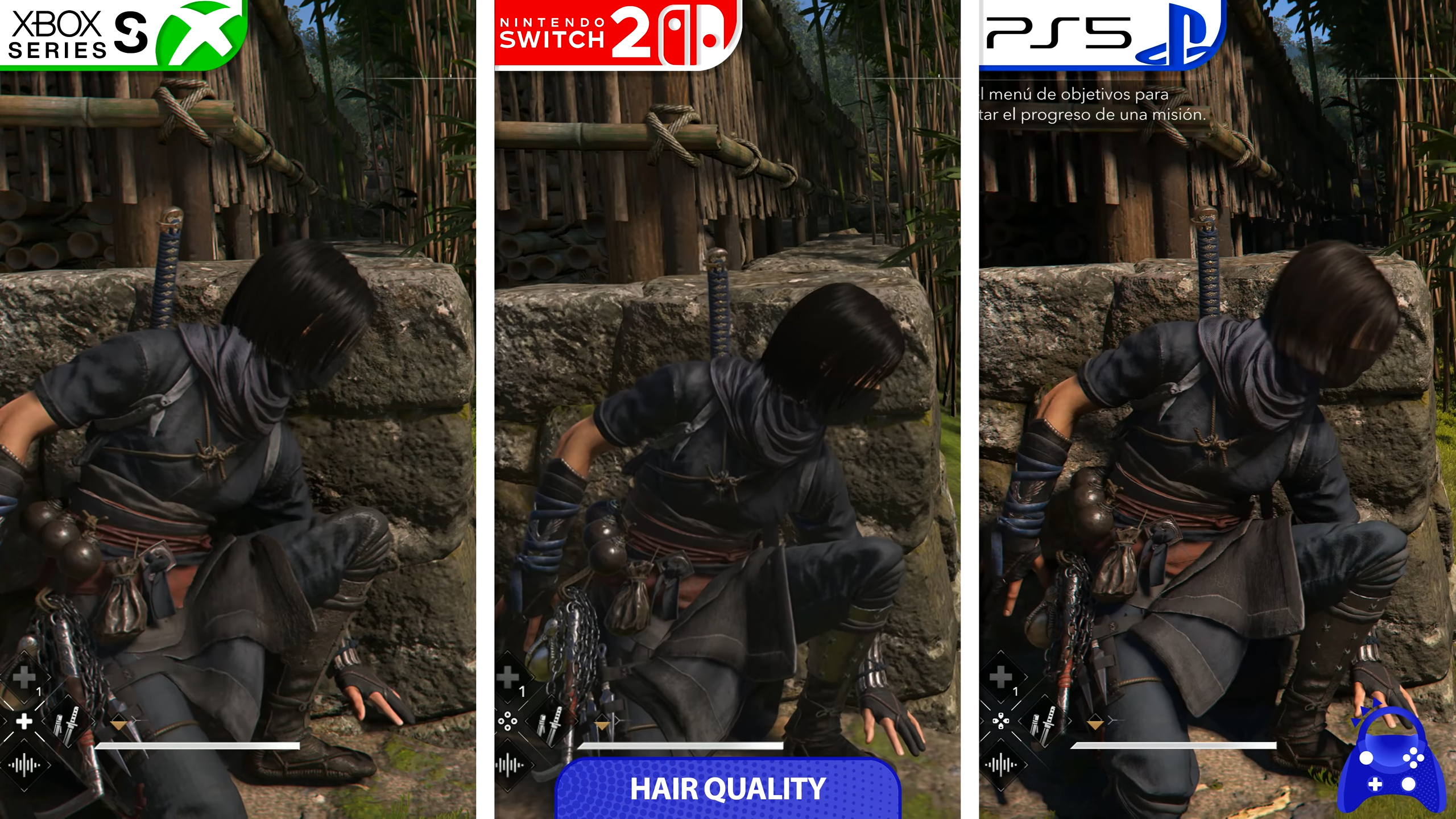
Assassin’s Creed Shadows arrives on the Nintendo Switch 2 with a single display mode, setting the stage for a direct comparison against the PlayStation 5 and Xbox Series S versions operating in their respective quality modes. The title, originally launched in March 2025 for PC, PS5, and Xbox Series X|S, is now preparing for its Switch 2 debut on December 2, 2025. This release represents a significant moment for Ubisoft, as the company attempts to scale a large open world and dual-protagonist structure to far smaller hardware.
The Switch 2 version features notable reductions across most visual elements when evaluated beside the other platforms. Lighting, level of detail, texture density, shadow quality, animations, draw distance, and reflections all show visible cutbacks. These changes are unsurprising given the hardware gap, yet they remain central to understanding how Ubisoft adapted 16th-century Japan, dynamic seasons, and a sprawling map to a more compact device. The game still manages to retain a reasonably good visual standard, and that consistency helps preserve the overall atmosphere of its late Sengoku period setting. The visual compromises do not fundamentally alter the narrative structure, which continues to revolve around the intertwined perspectives of Naoe and Yasuke.

Resolution on Switch 2 aligns closely with what was observed in Star Wars Outlaws, particularly in its reliance on DLSS to sustain clarity. The upscaling allows the game to look sharper than expected, even as it adapts complex environments and dense town layouts. Despite those gains, performance stability becomes the main challenge for the handheld hybrid. The Switch 2 build struggles to maintain a steady 30 FPS, especially in urban zones populated with higher numbers of NPCs. These areas push the hardware harder, and the resulting fluctuation is the primary technical drawback in this comparison.

Ubisoft faced a demanding optimisation process to deliver this version, and the effort is evident in how the game performs under typical conditions. Scaling an open world of this size, featuring stealth segments, parkour navigation, and heavy combat encounters, was clearly a difficult task. Even so, maintaining a functional baseline with an acceptable presentation across docked and handheld modes is a meaningful achievement. While the unstable frame rate remains a clear area for improvement, ongoing updates may help stabilise performance over time.