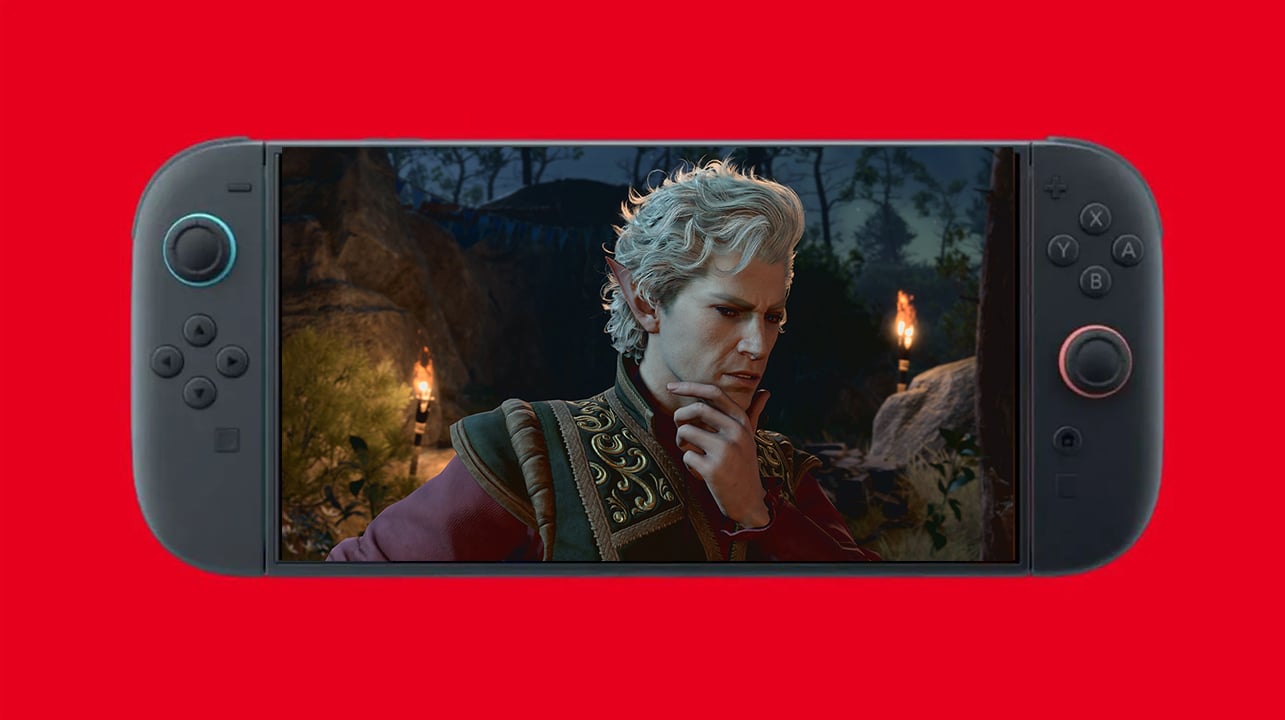
Larian Studios is unable to work on a Nintendo Switch 2 port of Baldur’s Gate 3 amid a shaky relationship with the IP owner, Hasbro.
During a recent AMA on Reddit, Larian Studios was asked whether a Nintendo Switch 2 version of Baldur’s Gate 3 is possible. Studio head Swen Vincke responded by saying that him and his team would’ve loved to work on a port, but the decision wasn’t theirs to make. Known insider Nate the Hate took to Twitter/X to offer further details on the matter.

According to Nate, while Larian Studios would indeed love to bring Baldur’s Gate 3 to the Nintendo Switch 2, its relationship with IP owner Hasbro is not healthy. Hasbro owns the Wizards of the Coast franchise and, by extension, the Baldur’s Gate IP.
During the AMA, Larian Studios also addressed growing concerns around the use of generative AI in game development, confirming that the studio has reversed its earlier position on using such tools during concept art development for future projects, such as the upcoming Divinity title. Vincke acknowledged the confusion caused by previous comments suggesting that AI tools might be used in the early stages of concept art development. While Larian Studios had clarified that AI-generated imagery would not directly become final concept art or in-game assets, Vincke admitted that the distinction was not clear enough to the community. As a result, the studio has now chosen to completely refrain from using generative AI tools in concept art development altogether.
According to Vincke, the decision was made to remove any ambiguity about the origins of Larian Studios’ artwork. By avoiding generative AI in this area entirely, the studio aims to ensure that there can be no debate over authorship, originality, or ethical concerns related to training data. That said, Larian Studios hasn’t ruled out the use of generative AI across the rest of its development pipeline. Vincke stated that the studio is constantly looking for ways to increase iteration speed, noting that faster experimentation often leads to better gameplay outcomes. In that context, the technology is being cautiously explored across departments as a potential productivity aid rather than a shortcut to creativity.