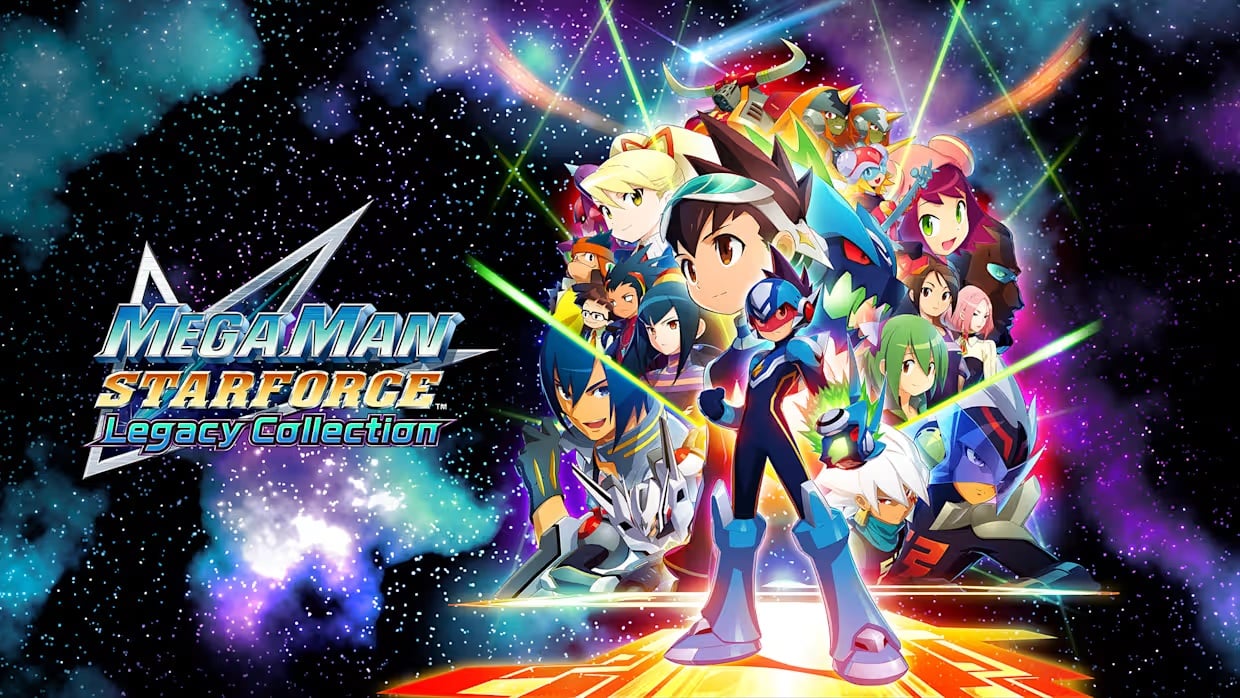
Mega Man Star Force Legacy Collection brings one of the more overlooked entries in the series back into the spotlight with a re-release on modern platforms. These games were the successors to the popular Mega Man Battle Network series, which received its own re-release earlier, but their reception in the West was relatively muted. For longtime Mega Man fans, this collection finally gives them a way to play through these games and experience the trilogy in its complete form from start to finish. It also includes several much-needed quality-of-life features, as these games were notoriously grind-heavy, helping improve the overall pace. In other words, the fat has been trimmed, and the end result is a collection that shines.
There are a total of 7 games from the Nintendo DS included in this collection. While there may be 7 games on paper, there are really only 3 at their core. Similar to the Pokémon games, there are multiple versions of the same title with minor differences. This trilogy focuses on the life of a young boy named Geo Stelar. Like the Battle Network games, Geo can transform into Mega Man, but here it is done through an alien being that can access the electromagnetic wave world.

The collection offers a solid set of quality-of-life improvements, such as the ability to skip or reduce turn-based random encounters, or increase movement speed. There is also a good amount of bonus content, including artwork, various in-game card packs, and music. Since the Nintendo DS used a dual-screen setup, Capcom has adapted this into a single-screen format, where the layout can be switched manually or changes automatically during certain key moments in the game.
As detailed in our earlier preview, this is one of those collections that benefits greatly from the new quality-of-life features. While it might not have received the same critical praise as the original Battle Network, revisiting these games now shows they are just as fun as they were at launch, especially when it comes to the combat system. The game also shifts to a more science fiction-focused storyline. Although the series found some popularity in Japan, with manga and anime adaptations, it never really gained traction in the West until now.

In the first game, the story is set in the fictional year 220X and introduces Geo Stelar. Since this takes place far in the future, society is no longer internet-based and has moved to electromagnetic wave technology, which feels functionally similar. Three large satellites, Pegasus, Leo, and Dragon, orbit Earth and play a key role in maintaining the EM Wave World. Geo Stelar, the main protagonist, loses his father in an unfortunate accident on a space station. One day, his father’s colleague visits and gives Geo a Visualizer, allowing him to connect with an electromagnetic alien named Omega-Xis. The story centers on an alien threat to humanity and Geo’s efforts to stop it alongside Omega-Xis.

The second game takes place a few months after the first. It introduces a new threat in the form of a character named Dark Phantom, tied to a cutting-edge device called the Star Carrier. The story follows a more episodic structure, with gradual updates to the main plot, and features several memorable boss battles. The third game continues directly after the events of the second. Society has changed following what happened in Mega Man Star Force 2, and a new technology called Wizards has been introduced. These are AI-based EM beings that act as digital assistants for humans. A new criminal group called Dealer emerges, capable of manipulating a force known as Noise, which can cause Wizards to go rogue and wreak havoc. Geo once again steps in to face this threat, and along the way, learns more about his father’s past and fate.

Each game in the collection gradually builds on the battle system while adding new features. The combat is fairly simple, combining random encounters with a grid-based system where players move Mega Man across a grid and line up attacks using a deck of battle cards with different properties. In the first game, players fight on a 3-by-5 grid, with movement limited to their side as they dodge attacks and position themselves to deal damage. Unlike the 2D presentation of the main game, battles take place in a 3D perspective. The second game introduces the Tribe On transformation system, which gives Mega Man new attack types and power-ups. This opens up more options in battle and allows for some fun combinations. One of the better additions in this collection is the ability to use special Wave Command Cards as bonus cards.
The third game focuses on the Noise system, which revolves around character transformations. Once a certain amount of Noise is built up, players can transform into powerful forms that unlock unique attacks and defensive abilities. This adds a more strategic layer to combat. The sequels also introduce new elements such as Star Cards and the Galaxy Advance mechanic, which draws inspiration from the Battle Network series.

Now, coming to the overall quality of the collection, it left a strong impression. The main menu presentation is stylish, and the bonus content is enjoyable to browse through. This is not just a simple re-release, as both the visuals and audio have been improved. Character portraits are rendered in high quality, the menus look sharp in higher resolution, and there are several customization options for those who want them. The quality-of-life improvements go beyond encounter rates and speed, also including optional tweaks like increased damage, healing, and defense that can be toggled at any time. The collection also features online multiplayer support across all seven versions of the games. There are three modes available: ranked, casual, and friend matches. While it was not tested extensively, it is something to explore further after launch.
Overall, this stands out as one of the better collections released by Capcom. They have managed to adapt the original dual-screen experience into a clean, modern package while adding a wide range of quality-of-life features. The inclusion of online multiplayer further strengthens it, making this the definitive way to experience the Mega Man Star Force trilogy.
Mega Man Star Force Legacy Collection Game Information
- Price: $39.99
- Publisher: Capcom
- Developer: Capcom
- Platform: PC (Reviewed)
- Disclaimer: A review code was given by the publisher