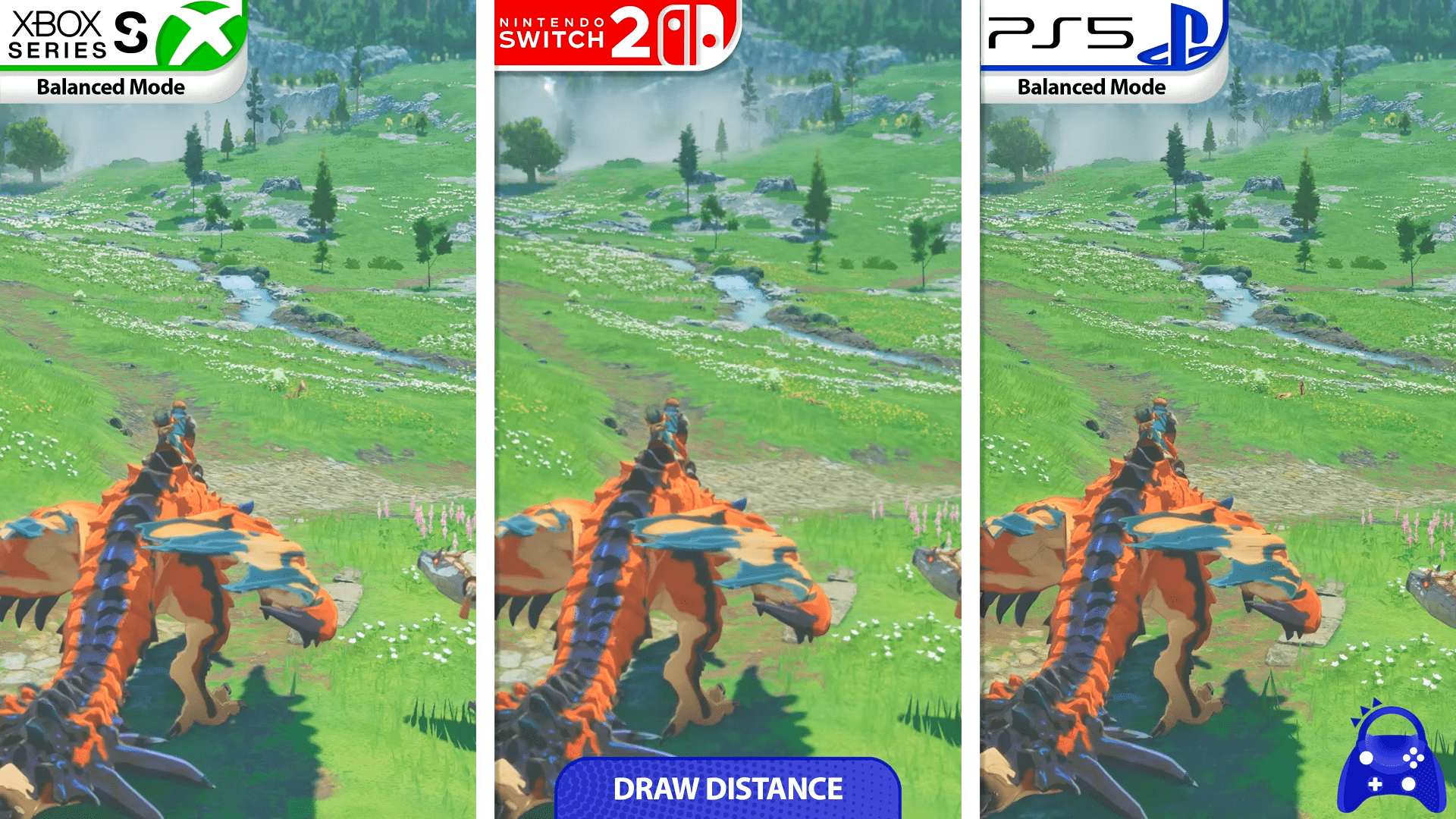
A new graphics comparison for Monster Hunter Stories 3: Twisted Reflection has revealed notable differences in visual quality and performance across Nintendo Switch 2, PlayStation 5, and Xbox Series S. The comparison focuses on resolution stability, frame rate behavior, and how each platform handles graphical settings across available display modes.
On PlayStation 5 and Xbox Series S, Monster Hunter Stories 3 offers three display modes, giving players options that balance performance and visual fidelity. In contrast, the Nintendo Switch 2 version includes only a single display mode, with no alternative performance or quality presets available. This immediately sets the Switch 2 version apart in terms of flexibility, though its overall presentation still aligns closely with the balanced settings found on other platforms.

The most noticeable differences between the various display modes appear in performance mode on PlayStation 5 and Xbox Series S. In this configuration, shadow quality and draw distance are significantly reduced in order to prioritize smoother frame rates. These visual sacrifices are clearly visible when compared to balanced or higher-quality modes, especially in larger environments and during exploration-heavy sections.
PlayStation 5 delivers the most consistent performance across all display modes. The console is able to maintain frame rates above its target in every setting, and in balanced mode it can even reach 60 FPS at times. As a result, balanced mode is considered the most recommended option on PS5, as it offers a strong compromise between visual quality and smooth gameplay without frequent performance drops.
Xbox Series S performs closer to PlayStation 5 than might typically be expected. Visually, its settings are surprisingly similar, particularly outside of performance mode. However, maintaining stability proves more challenging for Microsoft’s smaller console. While the visual output remains competitive, the frame rate is less consistent, with more noticeable fluctuations during demanding scenes.
On Nintendo Switch 2, Monster Hunter Stories 3 runs with settings comparable to the balanced mode found on the other platforms. In docked mode, the game demonstrates greater stability than the Xbox Series S version, holding its target frame rate more reliably. This gives the Switch 2 version a degree of consistency that stands out, especially when compared directly to Series S in similar scenarios.
However, performance on Switch 2 becomes less stable in portable mode. In handheld play, the game is more prone to dropping below 30 FPS, particularly during visually complex moments. While these dips do not fundamentally alter the experience, they are more frequent than in docked mode and highlight the trade-offs involved in portable play.

Monster Hunter Stories 3: Twisted Reflection is a turn-based role-playing game developed and published by Capcom. It serves as the third major entry in the Monster Hunter Stories spin-off series and centers on a Monster Rider who bonds with creatures known as Monsties. Set 200 years after a devastating civil war, the story follows rising tensions between the nations of Azuria and Vermeil, intensified by the birth of twin Skyscale Rathalos thought to be extinct.
The game introduces new mechanics such as Habitat Restoration and is scheduled for a global release on March 13, 2026, for Nintendo Switch 2, PlayStation 5, Xbox Series X and Series S, and PC via Steam.