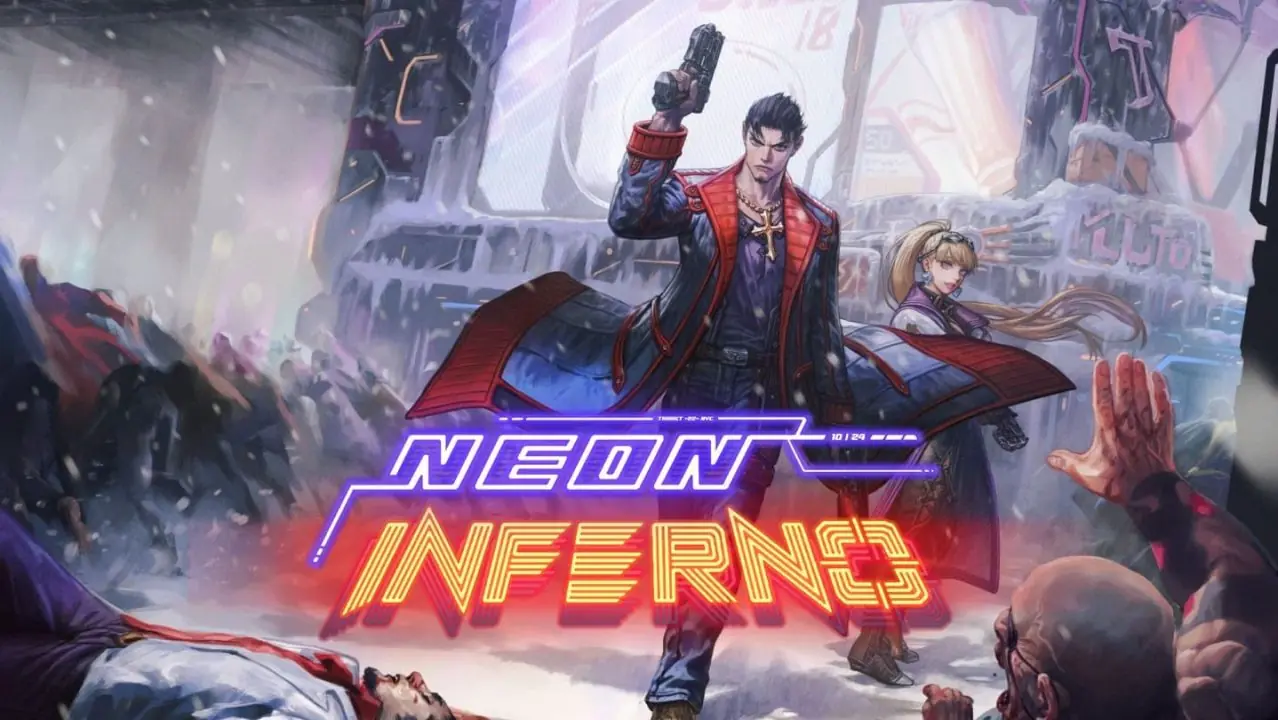
Set in a dystopian New York in the year 2055, Zenovia Interactive’s Neon Inferno throws the player into a violent urban conflict involving the Italian mafia, the yakuza, and an overwhelmed police force. The narrative framing is light and functional, serving mostly as an excuse to move from one action-packed scenario to the next.
The game follows a very traditional arcade game structure. You play as either Angelo or Mariana, both of whom come with identical abilities. The campaign consists of six stages, each built around pushing forward through waves of enemies until you reach a boss encounter. Across your playthrough, you’ll face mid-bosses, brief platforming sections, and occasional set pieces such as high-speed motorcycle shootouts. Some levels can be tackled in different orders, adding a small but welcome layer of flexibility.

What truly sets Neon Inferno apart from the flood of modern run and guns is its dual-plane combat system. While you’ll spend much of your time shooting enemies on the same plane as your character, in the vein of Contra or Metal Slug, the game also incorporates a background targeting mechanic inspired by classic gallery shooters like Cabal, Blood Bros, and Wild Guns. Using a cursor, you can aim and shoot at enemies positioned in the background. Doing so requires you to stand still, making you more vulnerable to incoming fire, and forcing you to constantly balance aggression with positioning. It’s a simple concept on paper, but it fundamentally splits your attention across two layers of threats.
Another prominent mechanic is the ability to deflect green projectiles with a melee attack. If you hold the button, the game briefly enters a slow-motion state, allowing you to aim the reflected bullet back at enemies. This system is particularly important during boss fights, where proper use of deflections can turn overwhelming patterns into manageable encounters. While conceptually strong, it doesn’t always feel great in practice, as it can occasionally disrupt the flow of gameplay rather than adding to it.

Angelo and Mariana are equipped with a basic pistol that comes with infinite ammo. There are no random health pickups or weapon drops during stages. Instead, survival depends entirely on your reflexes, pattern recognition, and efficient use of the game’s defensive mechanics. While the game tends to be quite challenging, it rarely feels unfair. Enemy attacks are clearly telegraphed and defeat usually feels like the result of player error rather than cheap design. Checkpoints do exist, though they can sometimes be spaced a little too far apart.
Neon Inferno offers multiple difficulty modes, including Beginner, Normal, Hard, and an Arcade mode that removes checkpoints entirely. Arcade mode, in particular, is a brutal test of endurance and memorization, clearly aimed at seasoned players who crave that old-school, one-credit-clear experience.

The Hard mode delivers what you’d expect, i.e., more bullets, tighter margins, harsher punishment, but feels somewhat conservative compared to recent genre standouts. It’s enjoyable and demanding, but doesn’t significantly remix encounters or introduce new twists. Multiple playthroughs are incentivized via in-game money earned based on performance, which can be spent on limited-use special ammunition such as homing shots, fire projectiles, or enhanced melee attacks. These upgrades can be extremely helpful in tougher encounters, but their high cost and short-lived nature make them feel like more of a last resort.
Neon Inferno is rather short in terms of length. A flawless run could see the credits roll in around two to three hours, though that scenario is highly unlikely on a first playthrough. Still, even accounting for retries and higher difficulties, the game leaves you wanting more. Additional modes, stages, or even a simple extras gallery would have gone a long way toward giving the game greater replay value. The lack of an online co-op mode is also a huge letdown, though the PS5’s Share Play feature does the job.
Where the game is virtually flawless is in its audiovisual presentation. The pixel art is exceptional, drawing heavily from the 16-bit era while layering in modern lighting effects, parallax scrolling, and animated environments that sell the cyberpunk tone without feeling cluttered. Character designs by Jun Tsukasa, known for his work on classic Psikyo shooters, add even more authenticity. The soundtrack complements the visuals, blending synth-heavy, Blade Runner-inspired tracks with rock and classical influences.

Lack of support for the PS5’s DualSense features, such as haptics and gyro/touchpad for cursor aim, feels like a bit of a wasted opportunity.
While Neon Inferno doesn’t reinvent the run and gun genre, it succeeds by delivering a tightly focused, mechanically confident experience built around a unique idea. Some systems could be more finely balanced, and the overall package could use more content, but the moment-to-moment action, excellent visuals, and unique design make it a standout for fans of classic arcade shooters.
Neon Inferno Game Information
- Price: $19.99
- Publisher: Zenovia Interactive
- Developer: Retroware
- Platform: PS5 (Reviewed)
- Disclaimer: A review code was given by the publisher