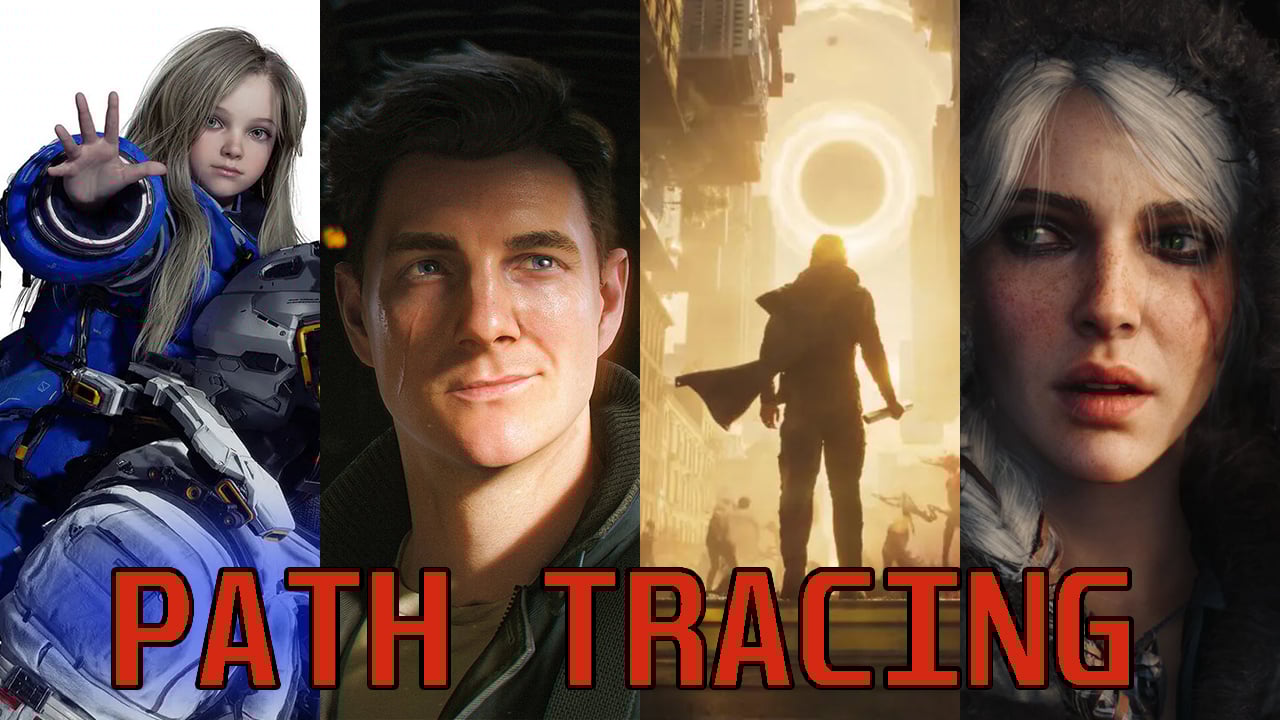
Pragmata, 007 First Light, Control Resonant, and The Witcher 4 are set to receive Path Tracing support on PC.
NVIDIA has revealed new details about the future of real-time path tracing in games, highlighting how the upcoming Pragmata, 007 First Light, and Control Resonant, and The Witcher 4 will implement the technology on PC. The GPU maker also showcased a new advancement called the RTX Mega Geometry Foliage System, which will play a key role in bringing fully path-traced forests to the next entry in The Witcher saga.

NVIDIA’s push toward fully simulated lighting began in 2018 with the introduction of the RTX architecture. Since then, successive hardware and software improvements have allowed developers to move beyond traditional ray-traced effects toward path tracing, a technique that simulates the complete behavior of light. Unlike selective ray-traced features such as reflections or shadows, path tracing produces unified global illumination and more physically accurate lighting. Recent games such as Cyberpunk 2077, Alan Wake 2, and Doom: The Dark Ages have already demonstrated the graphical potential of this approach.

To make path tracing viable in complex real-time environments, NVIDIA introduced RTX Mega Geometry last year. This system compresses scene geometry into clusters that can be processed far more efficiently than traditional methods. According to NVIDIA, Mega Geometry can update scenes up to 100 times faster than previous approaches while also reducing VRAM usage. The system is designed to handle extremely detailed environments, even those built with advanced level-of-detail technologies like Nanite from Epic Games. In practice, this allows developers to use higher-fidelity assets without overwhelming performance budgets.
The technology was recently implemented in Alan Wake 2 in order to improve performance, where existing assets were optimized using Mega Geometry to achieve better frame rates and lower memory requirements. Developer Remedy Entertainment is also implementing the system in its upcoming sequel, Control Resonant.

Forests and jungles present a major challenge for ray tracing because they contain millions of small, highly detailed objects, such as leaves, branches, grass, and other vegetation, often with continuous animation. Each of these elements adds complexity to ray-tracing calculations and acceleration structures, dramatically increasing memory and performance demands. NVIDIA’s Mega Geometry Foliage System introduces a new level-of-detail solution designed for this exact problem. The system selectively updates foliage geometry and represents it in a compact form that remains visually seamless while being efficient to ray trace. The result is the ability to render millions of animated plants with accurate lighting and shadows under a full path-traced pipeline.

This technology is being explored in collaboration with CD PROJEKT RED for The Witcher 4. According to the developer, the system will allow the game to feature fully path-traced forests, delivering dense foliage with intricate geometry and an unprecedented level of lighting realism. NVIDIA also confirmed that the Mega Geometry foliage system will become open-sourced later this year.