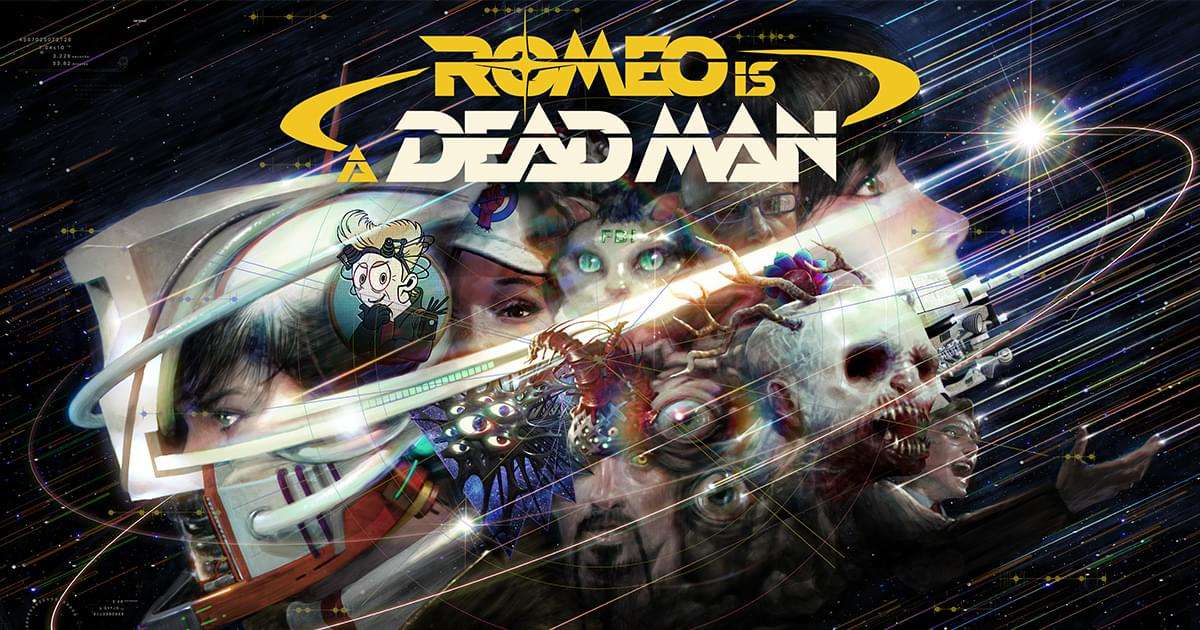
Suda 51 is no stranger to those who keep an eye on obscure, quirky Japanese games. He has a habit of creating things that are weirdly unique, often with limited mainstream appeal but strong cult status. He is also one of the few developers who consistently focuses on original IPs. While he turned the No More Heroes series into a trilogy, most of his other games have not been as lucky, usually ending as one-off projects. From Killer7 to No More Heroes, his work has built a strong legacy, which now continues with Romeo is a Dead Man.
Romeo is a Dead Man feels like a throwback to the PS2 and PS3 era, when mid-budget, offbeat games from Japan were far more common. As the name suggests, it draws inspiration from Romeo and Juliet, but adds a sci-fi, time-travel twist. The main character, Romeo Stargazer, appears to be an ordinary sheriff’s deputy in a small town in Pennsylvania, but his life quickly takes a strange turn. During a trip on the road, he finds a mysterious woman named Juliet who is suffering from amnesia. Romeo falls in love with her, but things spiral out of control when he is attacked by a bizarre creature. He is saved by his grandfather, Benjamin, a genius scientist, who intervenes at the cost of his own life. In the process, Romeo is turned into a cyborg, while Benjamin’s consciousness survives inside Romeo’s jacket.

If this story sounds confusing, that is intentional. The game fully embraces absurdity, constantly introducing strange and unexpected ideas. It is classic Suda 51 storytelling. The core goal of the narrative is to travel across different timelines and track down space-time criminals, one of whom is Juliet herself, and bring them to justice. Romeo is referred to as a Dead Man and joins the FBI’s Space-Time Police to hunt these criminals across time.
I have played and enjoyed most Suda 51 games, so it is fair to say I was the right audience for this new one as well. While the story barely makes sense and the character development is weaker than in some of his other titles, the game still manages to hold your attention by constantly trying to outdo itself narratively, even if it does not fully come together by the end. Beyond the story, the gameplay is also packed with strange quirks that sound completely absurd without context. This includes growing allies, called Bastards, by planting seeds in a garden, or playing various minigames to level up and improve the main character. This is a classic Suda 51-style game where, whether in gameplay or story, everything feels dynamic and deliberately different from more traditional experiences.

The core gameplay is centered on hack-and-slash combat, and it works well enough. The game offers both melee and ranged combat, with multiple weapons available for each. Light and heavy attacks can be chained together to form combos, and there is also a dedicated dodge button. Ranged weapons thankfully have infinite ammo, as the game tends to overwhelm the player with large groups of enemies rather than rely on carefully designed encounters.
Boss fights are more about spectacle and serve as the highlight at the end of each level, with unique encounters every time. While fighting regular enemies can start to feel repetitive, the story and presentation help keep things engaging. This is not a story that will appeal to everyone, but for someone like me, I really appreciated how it was told through a mix of traditional cutscenes and comic book-style pages.

The game does lack depth when it comes to gameplay. There are also sections where combat takes a back seat and is replaced by fairly mindless exploration, with the player simply moving between points of interest and pressing buttons. Overall, it feels like a less polished experience. The combat itself is also not very exciting and becomes repetitive over time. There is no real skill progression system, although weapons can be upgraded. Difficulty spikes are uneven as well, and the game can feel unfair at certain moments in the story. This is especially noticeable when a large number of enemies are thrown at the player in a small, confined space.
A major issue right now is the game’s performance on PC, which is simply poor. While this is an Unreal Engine 5 title, the performance at launch is frustrating, especially given that there is not much on display to justify it. I tested the game on two different setups and saw similar results on both. On top of that, the graphics settings menu does not seem to function properly. Even at a relatively low resolution of 1080p, the game struggles to reach 60 FPS on an RTX 3080 or an RTX 4070, which makes little sense considering the visuals are not particularly demanding.

If you are thinking about picking up Romeo is a Dead Man, I would still recommend it if you have enjoyed Suda 51’s previous work. That said, the game clearly needs some post-launch updates to address its performance problems. At least on PC, it feels close to unplayable right now unless you are able to brute-force through the issues with high-end hardware.
Romeo is a Dead Man Game Information
- Price: $49.99
- Publisher: Grasshopper Manufacture
- Developer: Grasshopper Manufacture
- Platform: PC (Reviewed)
- Disclaimer: A review code was given by the publisher