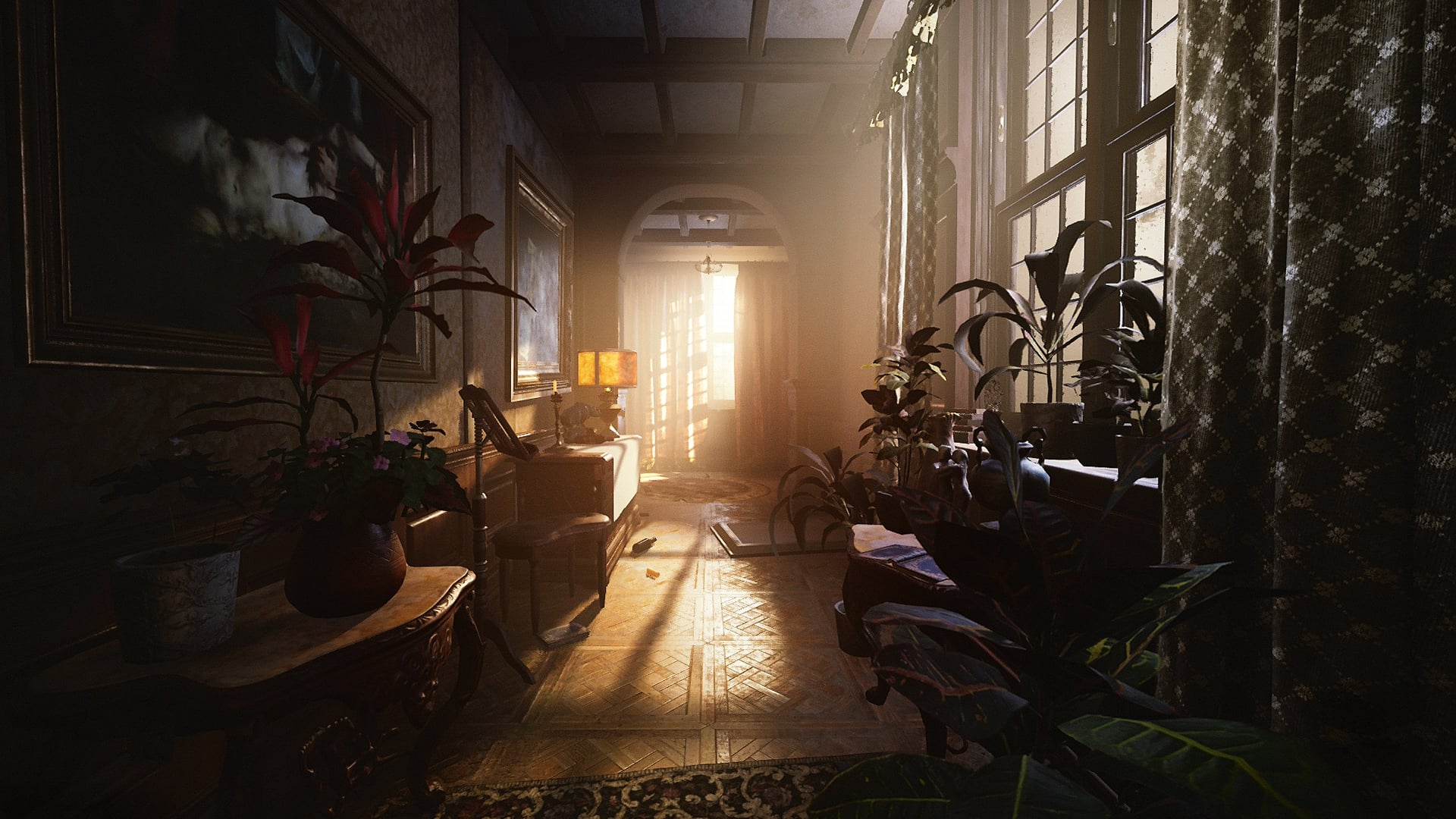
Digital Foundry has shared a detailed technical analysis of Layers of Fear: The Final Masterpiece Edition on Nintendo Switch 2, offering insight into how the Unreal Engine 5-powered title performs on Nintendo’s new hardware. The discussion took place during a recent Digital Foundry podcast and focused on resolution behavior, frame rate targets, and the extent to which Unreal Engine 5 features have been scaled back to meet platform constraints.
According to the team, the Switch 2 version is notable not because it is a flawless port, but because it serves as an early example of what Unreal Engine 5 can and cannot currently achieve on the system. While Layers of Fear is relatively contained in scope, its use of Lumen-based global illumination makes it one of the most technically ambitious titles available on the platform so far.
In docked mode, Layers of Fear targets a 1080p output resolution. Internally, however, the game operates at a significantly lower resolution using dynamic resolution scaling. Pixel counts discussed by Digital Foundry suggest that internal resolution frequently drops to around 540p, with occasional increases up to approximately 648p depending on scene complexity. To compensate, the game relies on image reconstruction, showing characteristics consistent with Unreal Engine’s Temporal Super Resolution or a lightweight NVIDIA-assisted upscaling solution rather than full DLSS.

The resulting image is described as generally stable, with acceptable edge reconstruction during slower camera movement. However, limitations are visible on larger displays, including reduced fine detail, softer textures at distance, and undersampled foliage. In handheld mode, internal resolution remains similar, but the lower pixel density of the screen helps conceal many of these artifacts, resulting in a cleaner overall presentation.
Performance is where the port becomes particularly interesting. In docked mode, Layers of Fear targets 60 FPS, a rare goal for Unreal Engine 5 titles on Switch 2, especially those using Lumen lighting. For extended stretches of gameplay, the game maintains this target with relatively consistent frame pacing. That achievement stands out, even if it comes with caveats.
Digital Foundry noted camera traversal stutter, where movement feels uneven despite frame rate readings suggesting stability. In addition, isolated sections suffer from severe frame time spikes, with performance briefly dropping to the equivalent of around 20 FPS. These moments are uncommon but noticeable. In handheld mode, the game no longer targets 60 FPS, instead running in the 40 to 50 FPS range with more frequent drops and persistent stutter.
To achieve these results, Unreal Engine 5 features have been heavily reduced. The game uses software-based Lumen without reflections, omits Nanite and virtual shadow maps, and simplifies shadows, volumetrics, and transparencies. These compromises are balanced by the game’s small interior environments and minimal simulation demands.
Overall, Digital Foundry characterized Layers of Fear on Switch 2 as a proof of feasibility rather than a definitive showcase. It demonstrates what is possible under tightly controlled conditions, while also highlighting how delicate that balance currently is.