NVIDIA has responded to criticism surrounding its newly announced DLSS 5 technology, clarifying how the system functions and emphasizing that developers retain direct control over how the technology affects the visual presentation of their games.
In a comment posted on YouTube, the company addressed concerns that the new neural rendering approach could override a game’s artistic direction. NVIDIA stated, “Important to note with this technology advance – game developers have full, detailed artistic control over DLSS 5’s effects to ensure they maintain their game’s unique aesthetic.” The company explained that developers can adjust parameters such as intensity and color grading, as well as mask specific areas where the effect should not be applied.
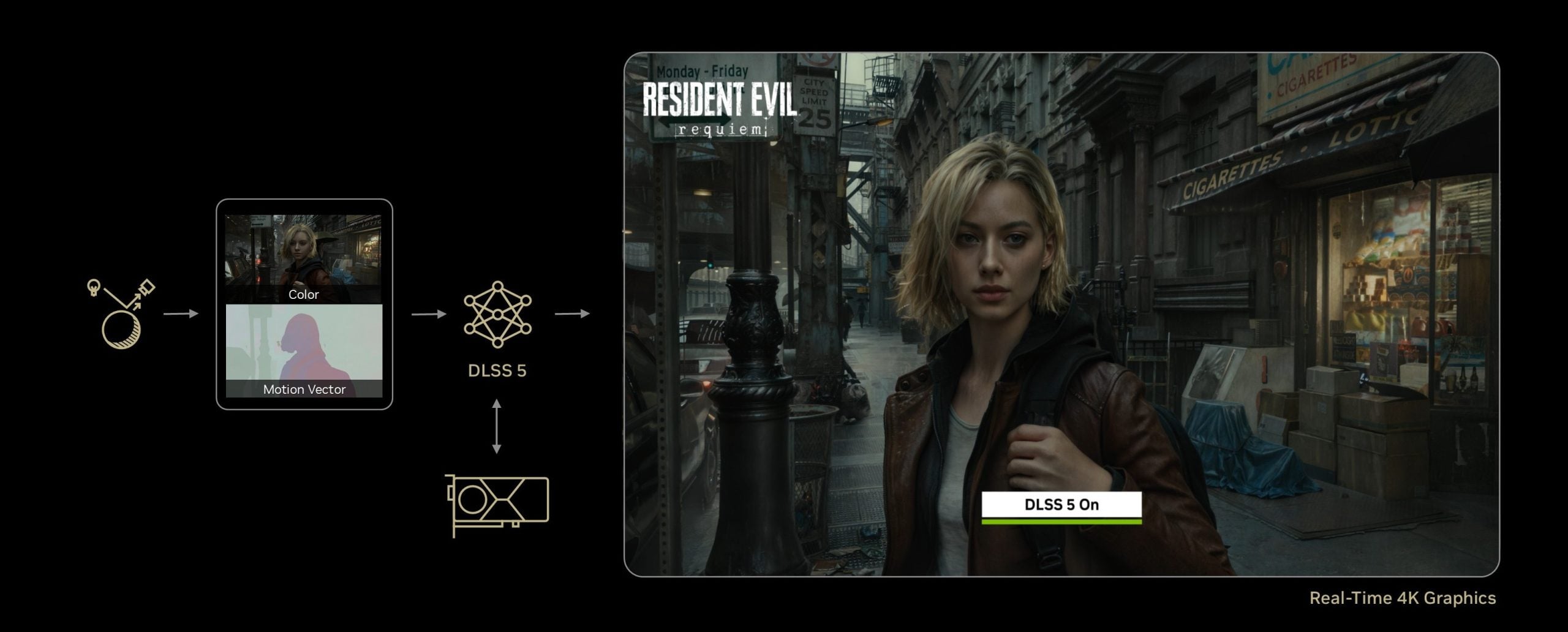
NVIDIA also stressed that the technology is not a simple visual overlay. According to the company, “It’s not a filter – DLSS 5 inputs the game’s color and motion vectors for each frame into the model, anchoring the output in the source 3D content.”

The clarification follows the recent unveiling of DLSS 5, the newest iteration of NVIDIA’s Deep Learning Super Sampling technology. The company previously described the system as a major advancement for real-time graphics, introducing a neural rendering model capable of generating photorealistic lighting and materials during gameplay.
NVIDIA says the technology blends traditional rendering techniques with generative AI in order to improve visual fidelity without sacrificing performance. The system analyzes each frame using color and motion vector data, then applies an AI model that reconstructs the image with enhanced lighting and material properties.
The company has positioned DLSS 5 as one of the most significant developments in graphics technology since the arrival of real-time ray tracing in 2018. NVIDIA CEO Jensen Huang previously described the new approach as a transformative moment for graphics, comparing its potential impact to the introduction of programmable shaders.