Valve Corporation has changed the advertised Steam Machine hardware capability from “4K gaming at 60 fps” to “up to 4k gaming.”
The official Steam store page for the Valve’s new living room PC has been updated (via Reset Era member Neat) with a change in its advertised hardware capability. As seen in the image below, the wording in the ‘CPU & GPU’ section of the promoted core features of the Steam Machine has been altered from “4K gaming at 60 fps” to “up to 4k gaming.”
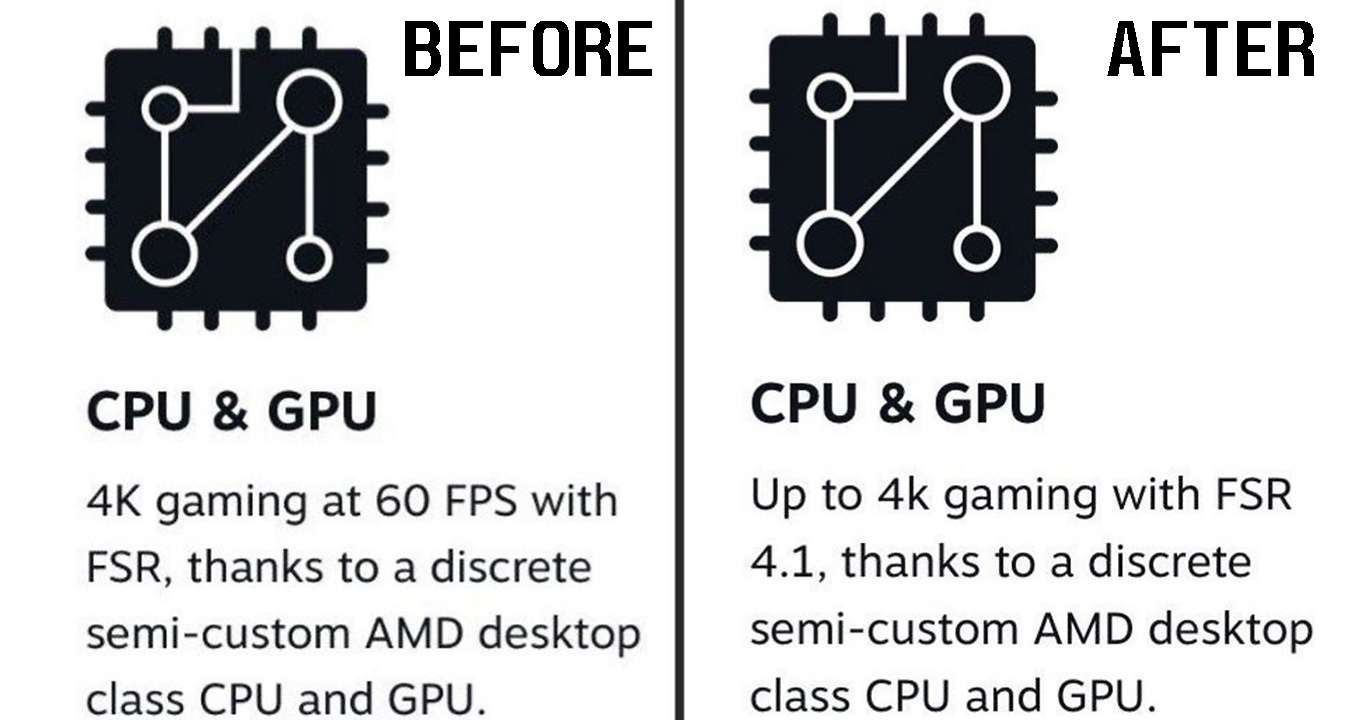
The aforementioned change in wording on the Steam Machine store page came after several reviews demonstrated that the console-sized PC is anything but a 4K gaming at 60 fps” capable machine when running modern AAA games. Additionally, the original statement mentioned FSR, but didn’t state which version would be supported by Valve’s living room PC. Now that AMD has made FSR 4.1 available for RDNA3 GPUs, the new description also reflects this change.
Content creator Gamers Nexus recently conducted a performance and pricing analysis of the Steam Machine, showing that consumers willing to build a DIY gaming PC can assemble a system with slightly better specifications for less money. He compared the 1,050 US Dollar 512GB configuration against a DIY desktop build using commercially available retail components that closely match the Steam Machine’s hardware on paper.
The Steam Machine contains a 6-core Zen 4 CPU, 28 RDNA 3 compute units, 16GB DDR5 system memory, 8GB GDDR6 VRAM, and an up to 2TB SSD. Given the semi-custom nature of the hardware, making one-to-one comparisons difficult. The DIY configuration outlined by the Gamers Nexus includes a Ryzen 5 7400F processor, Thermalright Peerless Assassin 120 SE V2 cooler, Gigabyte A620I AX motherboard, 16GB of DDR5-5600 memory, a 512GB NVMe SSD, Radeon RX 7600 graphics card, Cooler Master Q300L V3 case, and a 300W-class power supply equivalent. The content creator pointed out that the Steam Machine’s aggressive power limits result in lower real-world performance than the retail desktop components used in the comparison.