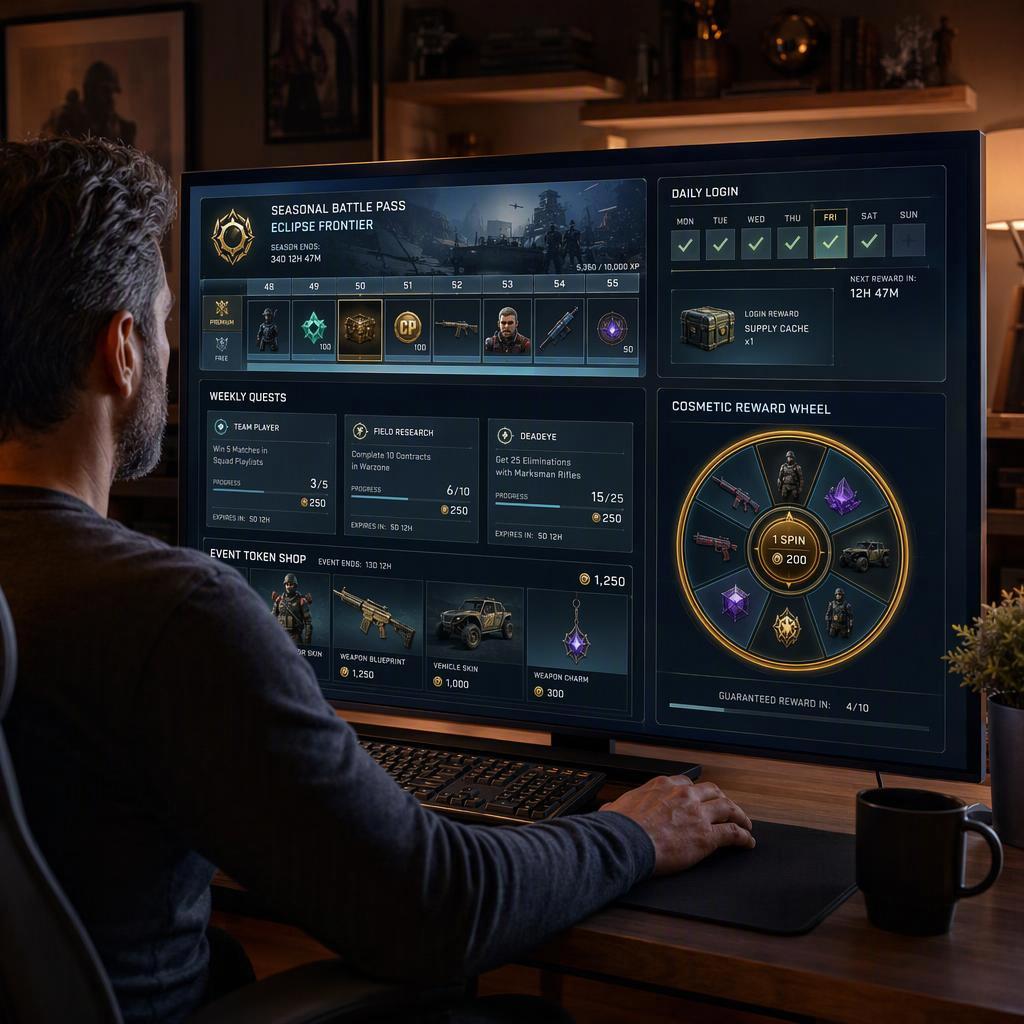
A fresh season is one of the clearest signs that a live-service game is still moving. New maps, themed cosmetics, balance changes and limited-time modes tend to grab the headlines, but the systems quietly holding the whole thing together are usually much smaller: a daily login screen, a quest list, a track of rewards or a wheel waiting to be spun.
It’s easy to dismiss these features as background noise. Yet they shape how people decide when to return, what to play next and whether a seasonal update feels worth their time.
The latest wave of live-service patches has continued the same familiar pattern. Seasonal launches arrive with a new progression track, event tokens, time-limited tasks and a promised set of rewards at the end of the road. Players don’t just turn up for one big reveal. They come back because there’s a visible reason to do so, whether that’s finishing a weekly challenge or reaching the next cosmetic tier before a season ends.
That doesn’t have to be manipulative. Done well, reward systems give players structure, choice and a pleasant sense that an evening’s play has led somewhere.
How daily reward systems are structured
Daily rewards are probably the simplest retention tool in gaming. Log in, collect a small item, and perhaps see tomorrow’s reward waiting on the calendar. It’s a gentle nudge rather than a complicated system, but its effect can be considerable.
For regular players, a login bonus can become part of a wider routine. You check the shop rotation, pick up an event currency, see which quests have refreshed and decide whether there’s enough to tempt you into a match or mission.
The better versions respect the player’s time. They don’t make you spend half an hour navigating menus, nor do they punish you heavily for missing a day. A sensible catch-up window or a non-consecutive calendar can make all the difference.
Reward wheels work on a similarly immediate level. They turn a small claim into a visible moment, with a clear pool of potential items and a result delivered in seconds. In a game setting, that might be an event token, a banner, a cosmetic item or an in-game resource.
The important part is not the spinning animation. It’s whether players understand what is available, how often they can take part and what happens if they receive something they already own.

How the progression loop fits together
Live-service games rarely rely on one reward type. They combine several systems, each serving a slightly different purpose.
Daily login bonuses
These are designed for low-effort engagement. You might receive a small currency grant, a consumable or a cosmetic fragment simply for opening the game.
A good daily reward should feel like a welcome, not a demand. If the item is useful but not essential, players can take it or leave it without feeling that they’ve fallen behind.
Quests and weekly objectives
Quests give players direction. Instead of opening a game and wondering what to do, you might see goals such as:
- Complete a set number of matches
- Use a particular class or loadout
- Visit a seasonal activity
- Help your team achieve an objective
- Collect items found during an event
The strongest quest systems allow more than one route forward. If every task forces a narrow style of play, people can start treating the game like a checklist. Offering rerolls, alternatives or broad objectives lets players stay with the modes they actually enjoy.
Event currencies
Seasonal currencies are often tied to a short-term activity. You complete event tasks, gather tokens and choose rewards from a themed shop. This can work very well because it gives players agency.
Rather than hoping a specific cosmetic appears at random, you can save towards the item you genuinely want. It’s a straightforward idea, but it matters. Choice makes progression feel more personal.
Battle-pass tracks
A battle pass, sometimes called a rewards track, lays out a season’s prizes in a series of tiers. According to Wikipedia’s overview of battle passes, the format commonly rewards players for normal play and specific challenges, with many games offering both free and premium tracks.
The attraction is obvious. You can see the route ahead.
There may be a character skin at tier 20, a currency bundle at tier 40 and a seasonal cosmetic at the final tier. That visibility turns progress into something tangible. You know what you’re working towards and, ideally, how long it should take.
Some newer passes also let you choose the order of certain rewards. That may sound like a modest change, but it improves the experience enormously. If you’re interested in one item more than another, being able to target it gives you a sense of control rather than simply moving along a conveyor belt.
Events work best when the goals are clear
Limited-time events are often where all these systems meet. There’s a themed activity, a short quest chain, currency to collect and a small catalogue of items that disappears when the event does.
That can be enjoyable. A seasonal event gives a game a sense of occasion, particularly when it changes the usual rhythm without asking players to learn an entirely new game.
Still, there’s a fine line between a well-paced event and one that feels like homework.
A player-friendly event usually has:
- A plain end date and time, shown in the player’s local region where possible
- Goals that can be completed through ordinary play
- A realistic route to the key rewards
- Clear information on whether cosmetics may return later
- Progress that carries over between relevant modes
- A clearly stated event period and proportionate completion requirements.
Cosmetic rewards matter here because they let players express themselves without altering competitive balance. A distinctive outfit, profile frame or weapon design can act as a memento of a particular season. You were there, you completed the event, and now you have something that marks it.
That’s much more satisfying than feeling obliged to log in solely to protect a streak.
The player-trust checklist worth keeping in mind
Reward systems are at their best when the rules are obvious. If you can’t tell what a timer means, how an item is obtained or whether a goal is possible, the design has already lost some goodwill.
Before committing time to a new event or battle pass, it’s worth checking a few basics.
1. Are the rules visible?
You should be able to find the event dates, eligibility conditions, progression requirements and reward descriptions without digging through several menus.
2. Are odds published where chance is involved?
If a game uses a randomised reward mechanic, clear probability information is a reasonable expectation where applicable. Published odds don’t tell you whether an item will suit you, but they do make the system easier to assess.
3. Is the progress target attainable?
Look at the number of tiers, the amount of experience needed and the number of days left. A good pass offers a practical path for ordinary play rather than assuming every player can log in for long sessions.
4. Is duplicate protection explained?
Nothing takes the shine off a cosmetic reward quite like getting the same item repeatedly. Systems that prevent duplicates, convert them into a useful alternative or explain the outcome clearly tend to feel much fairer.
5. Can you see the real value of each step?
This isn’t only about price. It’s about clarity. Are rewards cosmetic, functional or both? Does currency expire? Will your progress remain if you decide not to take a premium track? The more openly a game answers these questions, the easier it is to make an informed choice.
Sponsored / 18+ Context
Adult-only commercial destination. Reward-wheel mechanics also appear outside video games, though they should not be treated as equivalent to in-game seasonal rewards. Virgin Games’ slot rewards page is one example of an adult 18+ commercial reward-wheel format.
The useful comparison is about presentation, not participation: clear eligibility, visible terms, understandable timing and transparent information about what the mechanic involves all matter. Gambling involves risk and outcomes are not guaranteed. If you are in the UK and choose to gamble, keep it strictly for adults, set limits and consider support such as GamCare if gambling stops feeling manageable.
What to watch for in the next patch notes
When a new roadmap lands, don’t only scan for the headline feature. The details around rewards often tell you more about how a season will feel week to week.
Keep an eye out for:
- Changes to daily and weekly quest requirements
- Whether missed event days can be recovered
- New ways to earn seasonal currency
- Whether battle-pass rewards are linear or player-selected
- Updates to duplicate protection
- Clear expiry dates for event shops and tokens
- Notes on whether seasonal cosmetics may return
A well-made reward system gives you reasons to return without making you feel trapped by the calendar. It respects the fact that games are meant to fit around your life, not take it over.
So, when the next season launches, have a look beyond the splash screen. Check the timers, read the reward descriptions and pick the goals that actually appeal to you. The best live-service games make that choice feel simple.