New data shared by Circana’s Mat Piscatella highlights the continued long-term decline of physical video game sales in the US, although spending recorded a modest year-on-year increase for the first time since 2009.
Reposting the figures on Bluesky, Piscatella wrote, “Reposting the US physical software sales trend for folks wanting more context.”
He added, “I’m no fan of physical going away, but it wasn’t my call. And I get people are passionate on this topic. I’m not saying people shouldn’t be. Live your life.”
According to Circana’s Retail Tracking Service, consumer spending on new physical video game software peaked at $11.5 billion in the 12 months ending May 2009. Spending then declined for more than a decade, falling to around $1.5 billion in the 12 months ending May 2025.
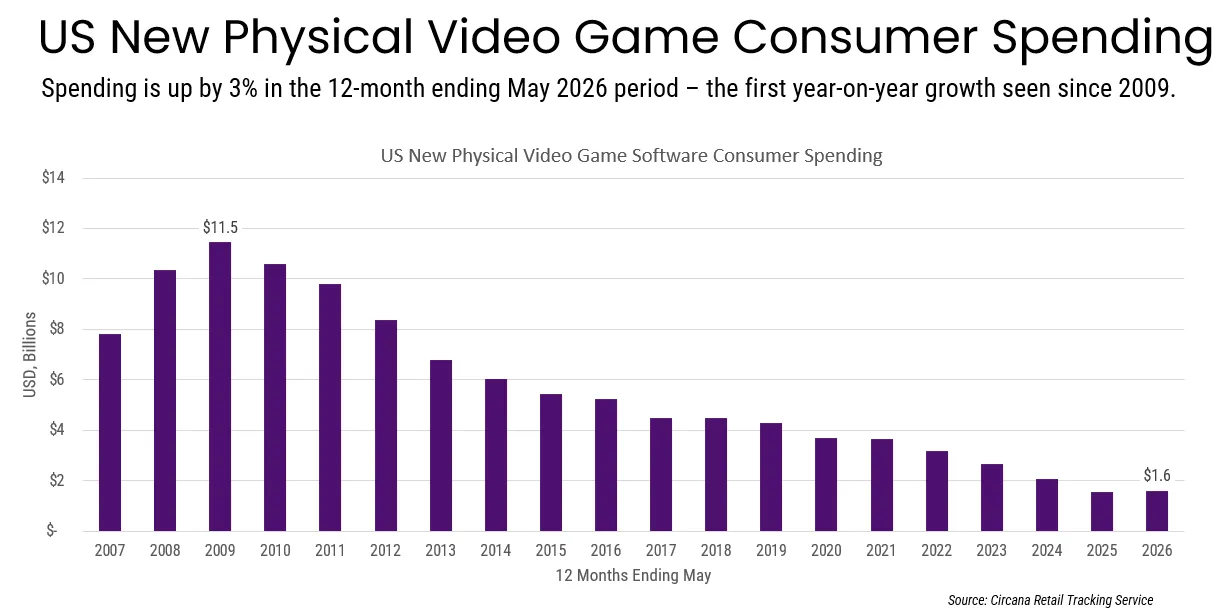
The latest figures show spending reached approximately $1.6 billion in the 12 months ending May 2026, representing a 3% increase over the previous year. Circana identifies this as the first annual growth in US physical game spending since 2009, although the market remains significantly smaller than it was at its peak.
Piscatella also addressed regional differences in physical software sales, saying, “The console manufacturers have all the data on sales and play that take place on their platforms globally in mind boggling detail.”
He continued, “Yes, physical currently matters far more in some places than it does in others, and digital isn’t a great an option in some places. The console mfgs know all that.”
Responding to ongoing debate around physical media, Piscatella later added, “Three options: 1) The data was incorrect 2) The market has changed 3) The data is correct and still represents the market, yet the decision was made anyways.”
Niko Partners analyst Daniel Ahmad also commented on the figures, noting that Nintendo remains the primary driver of physical software sales. He wrote, “Worth noting the majority of that rn is Nintendo Switch / 2 software. Which is why Nintendo hasn’t (and won’t this generation) followed in Sony’s footsteps.”
The latest data suggests that while the US physical games market may have stabilised slightly after years of decline, Nintendo continues to account for a significant share of retail software sales as digital distribution becomes increasingly dominant across the wider console market.