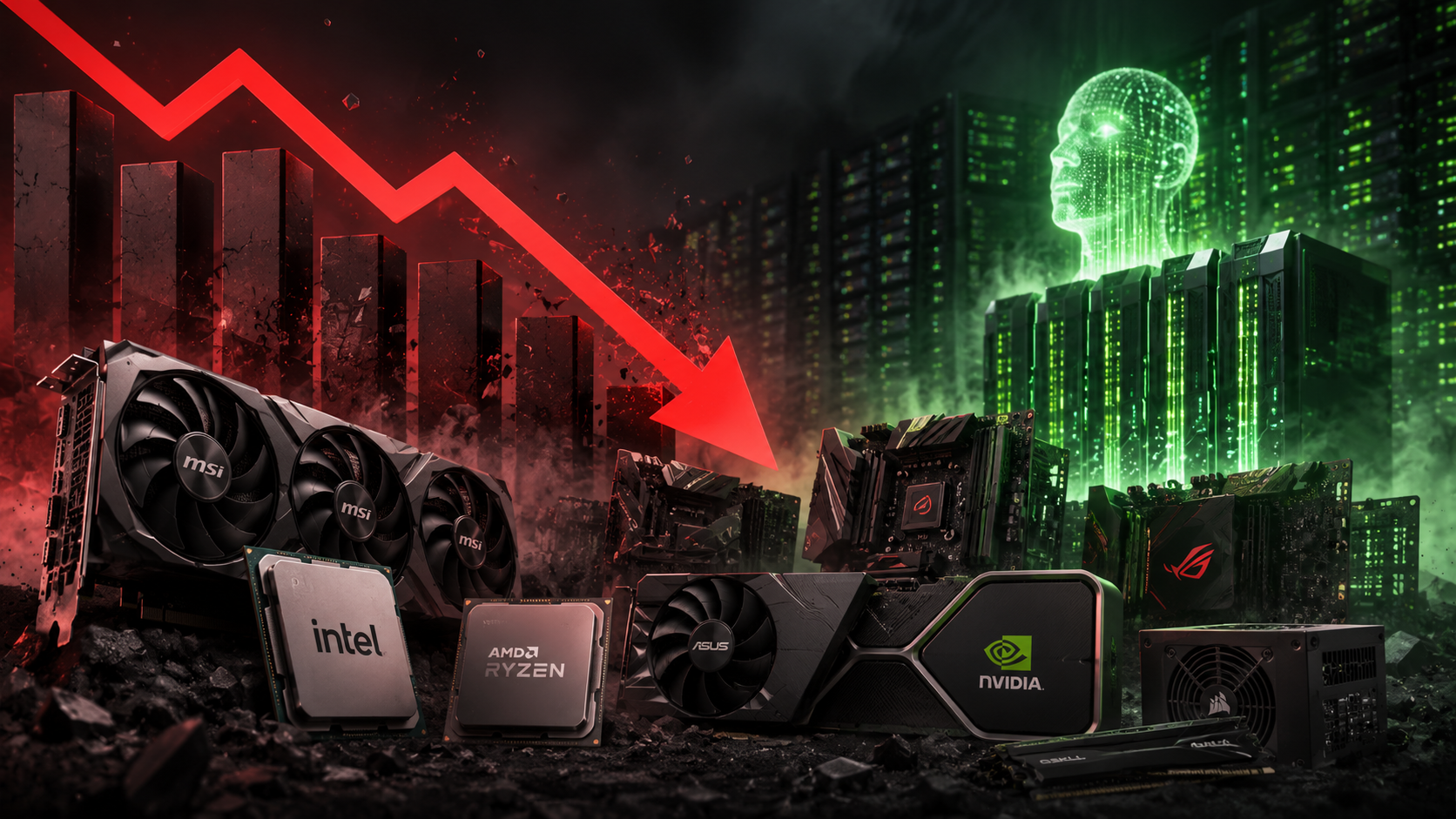
A new report from DigiTimes suggests the PC gaming hardware market is facing a significant slowdown as rising AI demand continues to impact component availability, pricing, and consumer interest in upgrades.
According to the report, shortages and price increases affecting CPUs and memory are creating mounting pressure across the PC industry. Supply chain sources cited by DigiTimes claim that major Taiwanese motherboard manufacturers have lowered their 2026 shipment targets, with some reportedly seeing steep declines compared to earlier projections.
The report states that “the PC DIY market is in dire straits,” pointing to a combination of higher hardware costs and slowing GPU upgrade cycles. It adds that “NVIDIA GPU updates and upgrades have slowed down, leading to a significant decrease in gamers’ willingness to purchase.”
Memory pricing appears to be one of the biggest factors affecting the market. DigiTimes reports that memory costs have risen from roughly 15% of a system’s bill of materials to more than 30%, forcing manufacturers to either increase prices by 10% to 20% or reduce specifications on new systems.
The report also claims that Intel and AMD are prioritizing production capacity for higher-margin data center processors as AI demand grows. “With the rise of agentic AI, the role of CPUs in AI inference architectures has been elevated,” the report says, adding that consumer-grade CPU supply has been constrained as companies shift focus toward products like Xeon and EPYC.
AMD CEO Lisa Su was also cited as saying that rising component costs have negatively affected Ryzen shipments and that PC and gaming demand is expected to decline during the second half of 2026.
NVIDIA’s gaming GPU roadmap is another area highlighted in the report. DigiTimes claims that no major RTX 50 series refreshes have appeared this year due to the stronger profitability of AI-focused GPUs. The report further states that the next-generation RTX 60 series is rumored to be delayed until 2028, leaving the high-end gaming PC market without a major technological push to encourage upgrades.
Several motherboard manufacturers are reportedly being hit hard by the slowdown. ASUS is said to be struggling to maintain shipments above 10 million units, while Gigabyte, MSI, and ASRock are all forecast to post substantial year-over-year declines.
Despite weakening demand for gaming hardware, the report notes that AI server business has become a major growth area for companies like ASUS, Gigabyte, and ASRock. Server-related revenue is reportedly offsetting losses from motherboards and graphics cards as manufacturers increasingly shift focus toward AI infrastructure products.
While the broader PC market had shown signs of recovery previously, DigiTimes suggests the combination of inflation, rising component prices, and AI-driven production shifts could push the gaming hardware sector into another downturn during 2026.