A 100GB download can sound like proof that a game is bigger, richer, and more advanced. Sometimes it is. More often, file size is only the container. It tells you how much data is being installed, not whether the player will feel sharper movement, clearer goals, or a better first hour. The real test is the loop the game asks you to repeat.
That is why modern game size should be discussed alongside learning, pacing, and readability. A game can have huge textures and cinematic audio yet teach clumsily. Research on in-game tutorials and implicit guidance highlights how timely feedback and player practice affect how people learn new systems, whether the title is a massive RPG, a platformer, a racer, or a compact browser-based release.
Smaller Loops Show Their Value Immediately
Not every new game experience is built around a long install, a 20-minute cinematic opening, or a tutorial that slowly reveals the game’s mechanics. If you want to see how modern games can function without that kind of heavy setup, it can help to look at a collection of bitcoin games. While most people think of bulky, triple-A titles when they talk about gaming, smaller and more lightweight formats are also useful design examples because they often rely on fast readability rather than long explanations. These titles can introduce a theme, rhythm, and basic interaction quickly, without requiring large downloads or asking the player to work through a complex tutorial before understanding the core loop.
The comparison is not about matching the scope of an open-world blockbuster. It is about how compact formats communicate theme, pacing, feedback, animation timing, and basic interaction almost at once. When a player first opens a Bitcoin-supported casino title, the game has to explain itself through sound, motion, visual clarity, and rhythm, because there is little extra space for a long narrative setup. By directing the player’s attention to the most relevant parts of the screen through motion, and pairing events in the game with clear sound cues, many compact casino games can explain their mechanics to new players without needing a detailed tutorial.
That same principle applies across games of every size. A large release can impress with scale, but if players get bored going through the tutorial, much of that content may get missed completely. Therefore, developers of large-scale games can still learn from the way smaller titles teach players through implication, pacing, and audio-visual cues, instead of explaining everything directly.
It’s surprising how effective game developers can be when working with restrictions, and this doesn’t just apply to teaching without a tutorial either. This short breakdown of memory limits in gaming explains how early developers reused tiles, sprites, enemies, sounds, and side-scrolling layouts because every asset had to justify its place. The result was readability. Players learned danger, timing, safe ground, and reward patterns because levels repeated familiar pieces in interesting arrangements.

Why Modern Games Have Become So Heavy
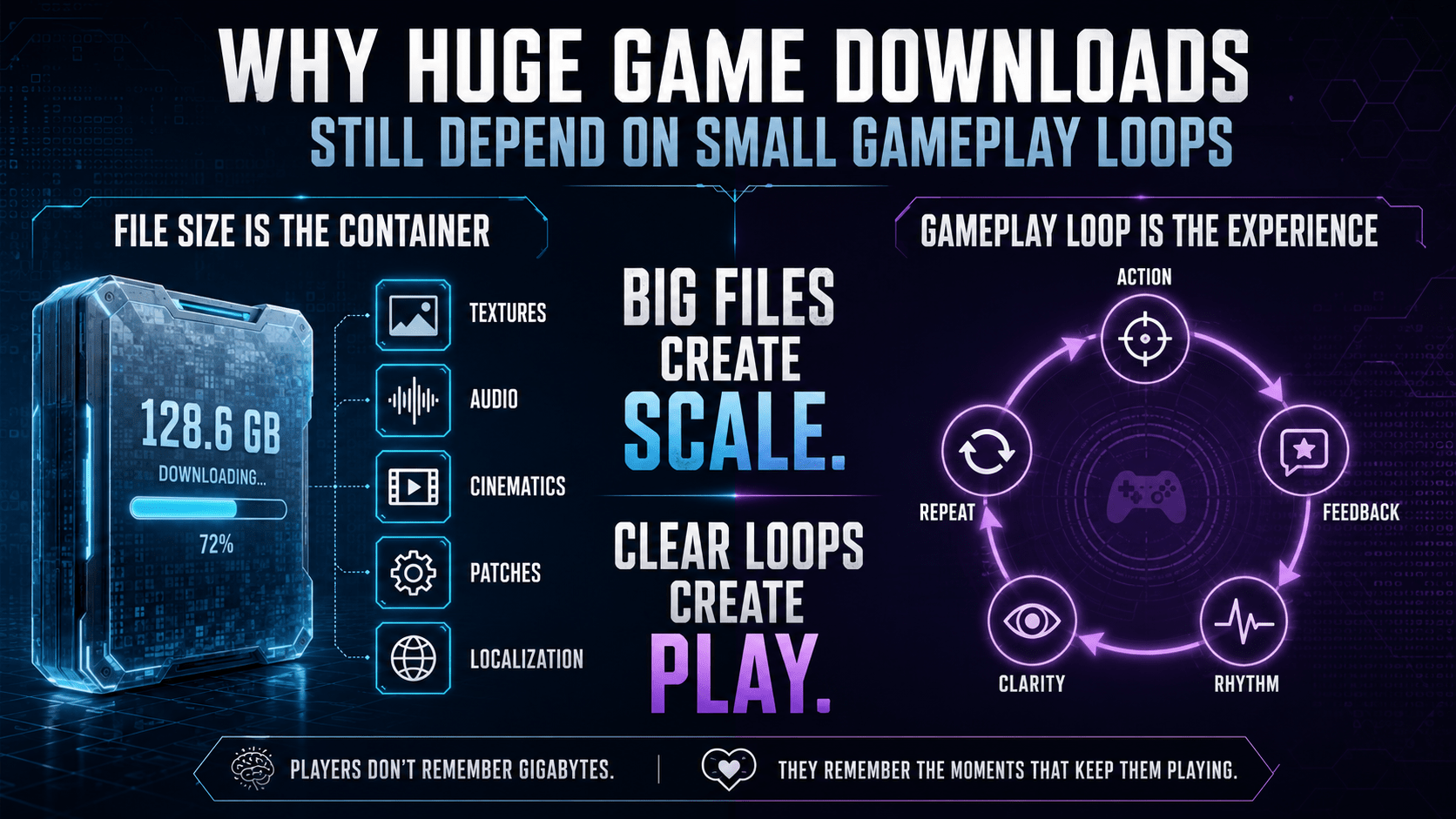
The common answer is “better graphics,” but that is only part of it. Modern games carry high-resolution textures, detailed models, cinematic files, voice tracks, language packs, lighting data, animation variations, patches, and platform-specific data. Open worlds need large asset pools so areas do not feel obviously copied.
Storage is shaped by performance choices too. Developers often have to choose between optimizing their games to run fluidly and optimizing them to be space efficient. Compression saves space, but decompression takes processing time. Fast SSDs have changed this landscape a little, but there is still a trade-off between storage, memory, load times, and visual ambition.
That is why file-size reporting remains useful. When a release gets smaller, it tells players something about packaging, patch structure, or asset handling. A recent example is the report that a Call of Duty HQ PS5 update would reduce the app by over 100GB, showing that size is a pipeline story as much as a content story.
The Design Density Test
A player rarely experiences a game as data. They experience it as repeated action and response. The question becomes simple:
This is where older design logic still matters. Retro games could not rely on endless bespoke assets, so the same pieces had to do more. A platform could be a timing lesson, a safe zone, a height marker, or a setup for the next enemy. A simple enemy taught spacing, movement, and game mechanics.
Modern games have more room, but room can soften discipline. If every scene has unique details, the player still needs to know what matters. If every map marker is beautifully rendered, the route still needs intent. If every animation is expensive, the timing still has to feel fair.
Scale Helps, But Feedback Decides
Large downloads can support better games. They can hold richer worlds, fuller soundscapes, sharper textures, and more expressive characters. For many current-gen titles, that data is part of the appeal. The mistake is assuming that size itself is the achievement.
The best games make their loops understandable before they make them deep. First, the player feels the action. Then they notice the pattern. Then the game changes the pressure. That sequence is why a tiny retro level can stay memorable, while a huge map can fade if interactions blur together.
Modern games are often massive because they carry assets, audio, localization, cinematics, and streaming data older games never could. But the part players return to is smaller and more human: the repeated action that creates skill, memory, and flow. As one framework on player-game interaction argues, gameplay emerges through repeated core interactions, which is why the loop matters for years after the download finishes.